An important difference between film and video is the shape of the frame. The height and width for this proportion is called aspect ratio. Up to the year 1952 standard film ratio of a frame was three units high by four units wide. (also expressed as 1:33:1). This was found by Thomas Edison. In 1953 a more lasting change was signaled after the 20th Century Fox brought out the biblical epic The Robe in CinemaScope. The development of wide-screen formats later followed. In 1940, Stereophonic sound also became standard after the introduces Disney`s Fantasia.
Still today the widest aspect ratio at 2.35:1 the CinemaScope remains although new moderately widescreen formats are used to shot films or the Standard Academy ratio of 1.85:1, or the foreign Theatrical standard of 1.66:1.
However,Wide-screen formats require special lenses on the camera and projector that permits the wide image to be compressed onto a normal film frame, then uncompressed when projected. These are called anamorphic. The old ratio discovered by Edisons old ratio of 1:33:1 remains the standard for ordinary broadcast television.
We now have advanced digital video systems for motion pictures(High Definition video). They are also wide-screen but use a unique aspect ratio of 1:78:1.
Reference: Benedetti, R, Brown, M, Laramie, B, Williams, P 2004, pp.22-23,Creative postproduction, Pearson Education,Inc.
From the research
I exported my final video in four different file formats to see what the differences were between them all. The final export will be the settings of a video that will be aimed to go on the web.
From this the differences were file size and quality of video. For example, Microsoft AVI was good quality but a large file size and H.264 was a reasonable file size but lost some colour to the video.
If I was to think about the end result being put on the Internet, then the file size would be more important then the colour lost so I would export the video out of Premiere as H.264, but if it was to go onto DVD then file size for this video would be okay to export as Microsoft AVI to have better quality.
For both exports I set them to wide-screen high quality.
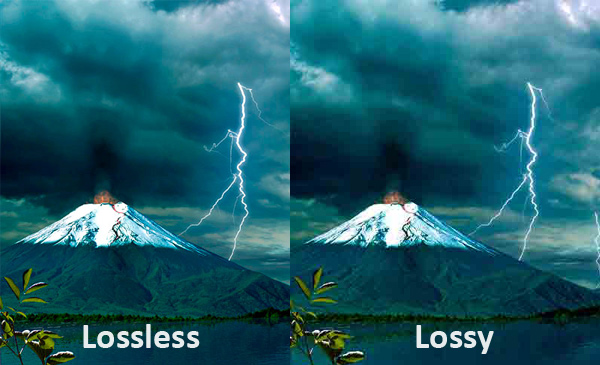
Example of Lossless and Lossy:

Reference for image: http://www.pxleyes.com/blog/wp-content/uploads/essential-video-formats-for-cg-artists/lossless1.jpg

No comments:
Post a Comment